Campaigners Furious at Friary Park 'White Elephants'
Two towers containing over 300 flats sit empty during housing crisis
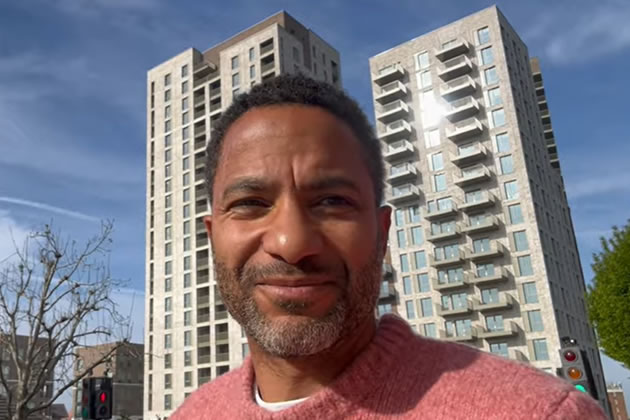
The two towers behind Sean Fletcher remain empty despite being completed. Picture: Cap the Towers
May 7, 2026
Three hundred flats, two towers, zero residents. As the luxury flat market falters across London and overseas investor interest dries up, the warnings that Acton campaigners spent years making are beginning to look prophetic.
Somewhere in the gleaming towers of Phase 2 of the Friary Park development — branded by the developer as The Verdean — the lights are off. According to TV broadcaster and local resident Sean Fletcher, a leading voice in the Cap The Towers campaign, around 300 completed flats in two towers, one of them 22 storeys high, are sitting empty. Nobody is living in them. Nobody, it appears, is about to move in.
"It is a complete disgrace," says Fletcher in his latest video as part of the long running campaign against the way the estate is being developed. The flats, he says, were marketed exclusively in Singapore as luxury accommodation, designed not for local families or young Londoners struggling to get on the housing ladder, but for what Fletcher calls "the global rich." Buyers, he adds, have now turned their attention to more profitable investment destinations — cities like Manchester and Birmingham, where yields may be more attractive and the economics of property investment less strained.
Meanwhile, across the borough of Ealing, the need for social housing stands at over 12,000 households, according to Cap The Towers. That figure, alongside the image of hundreds of empty flats in a completed residential development, is the central scandal that Fletcher says the campaign group has now uncovered.
Mount Anvil, the developer behind the scheme, had stated at the end of last year that the towers were due to be occupied by the end of March.
The Friary Park estate in Acton has a history stretching back to the late 1980s, when Laing Homes built it for private sale. It was purchased by Catalyst Housing Association (then known as Ealing Family Housing Association) in 1988, and for decades it was home to a settled community of tenants.
Consultation on its regeneration began in 2014, and in 2019 Mount Anvil and Catalyst received planning permission from Ealing Council for a 990-home mixed-tenure development, to be built in three phases. The scheme promised 45% affordable housing, improved green spaces and community facilities, and new social rented homes — all within a five-minute walk of Acton Mainline station.
Two separate assessments from government assessors and independent experts DS2 both concluded, at the time of the 2019 application, that the scheme was "not viable." Ealing's planning committee approved it regardless, by 11 votes to one.
That decision set a pattern that would repeat itself. In 2022, Mount Anvil returned with a second application to add a further 238 flats — including a new 17-storey tower of entirely private, high-profit housing — bringing the total to 1,228 homes across twelve blocks. The revised viability assessment again raised concerns. The planning committee again voted to approve it, once more by 11 votes to one.
It was the 2021 plans to dramatically increase the height of the towers — at one point proposing a 37-storey and a 29-storey block — that galvanised Acton residents into action and gave birth to the Cap The Towers campaign.
Fletcher, who presents programmes on the BBC and ITV and lives locally, became one of its most prominent voices. He was joined by fellow campaigner David Tennant, and the group attracted support from then-MP Rupa Huq, who described the development as an "oversized monster" that would do "nothing to help 10,000 people on Ealing Council's housing waiting list."
In one early victory, Cap The Towers — backed by more than a thousand emails from local residents — forced the developers to abandon their plans to increase tower heights to 37 and 29 storeys. "There'll be no increase in the height of the six towers," the developers conceded.
But the campaign's concerns extended well beyond height. From the beginning, Cap The Towers had drawn attention to the way flats in Phase 1 and Phase 2 were being sold: not to Londoners, not through conventional estate agents, but off-plan in the Far East and Middle East. The group uncovered video and documentary evidence of Friary Park properties being marketed to buyers in Singapore, Saudi Arabia and other overseas markets by agents including Savills. As Fletcher put it at the time: "I am shocked to see that developers are marketing the Friary Park flats as investment properties in the Middle and Far East ahead of Londoners. The people of Ealing and London don't want their community to be turned into an investment hub for the global rich."
The campaign also pursued Ealing Council over its conduct. In December 2023, Fletcher wrote to all 70 Ealing councillors warning that the planning department had, in collaboration with Mount Anvil, attempted to remove all references to building heights from the formal description of the development — a so-called Non-Material Amendment that the group argued was, in fact, anything but minor. The letter went unanswered. A planning officer, the group says, admitted that the purpose of the change was to leave the door open to further height increases in future.
Controversy did not end with Phase 2. In April 2025, Ealing Council's planning committee — voting unanimously — approved Phase 3, comprising a further 693 homes in five blocks rising up to 24 storeys on a 1.13-hectare site, bringing the total to 1,345 homes. Of those 693 new flats, just 37 will be for social rent.
Fletcher makes one of the most striking claims of the whole saga: that despite the enormous scale of construction at Friary Park, there are now fewer social rent homes on the site than there were on the original three-storey estate it replaced. Homes for Londoners, the development's marketing tagline, was always, the campaigners say, something of a fiction.
What makes the situation at Phase 2 all the more sobering is the wider context of London's luxury flat market — which, over the past two years, has deteriorated sharply.
London flat prices, already stagnating, have continued to underperform houses by a wide margin, with central London flats averaging values far beyond what domestic buyers can afford, while investor demand softened. The cost difference between London flats and suburban houses is now at its highest since 1998. Monthly mortgage payments on London flats remain some 40% higher than 2021 levels.
For investors — particularly those in the Far East who were targeted so specifically by the Friary Park marketing machine — the sums increasingly don't add up. Other British cities have emerged as more attractive destinations for yield-seeking capital. The investor base that was supposed to underpin the financial model of schemes like The Verdean has, in many cases, simply looked elsewhere.
If the flats in Phase 2 remain unsold or unlettable, this raises more questions about the viability of Phase 3, a scheme that has already been described as generating insufficient affordable housing and which rests on a similar financial model? And if the developers face continuing financial pressure, is there any risk that the affordable housing commitments — already whittled down through successive planning rounds — could be revisited?
We have contacted both Mount Anvil and Ealing Council for comment on the claims made in Sean Fletcher’s video.
Like Reading Articles Like This? Help Us Produce More This site remains committed to providing local community news and public interest journalism. Articles such as the one above are integral to what we do. We aim to feature as much as possible on local societies, charities based in the area, fundraising efforts by residents, community-based initiatives and even helping people find missing pets. We’ve always done that and won’t be changing, in fact we’d like to do more. However, the readership that these stories generates is often below that needed to cover the cost of producing them. Our financial resources are limited and the local media environment is intensely competitive so there is a constraint on what we can do. We are therefore asking our readers to consider offering financial support to these efforts. Any money given will help support community and public interest news and the expansion of our coverage in this area. A suggested monthly payment is £8 but we would be grateful for any amount for instance if you think this site offers the equivalent value of a subscription to a daily printed newspaper you may wish to consider £20 per month. If neither of these amounts is suitable for you then contact info@neighbournet.com and we can set up an alternative. All payments are made through a secure web site. One-off donations are also appreciated. Choose The Amount You Wish To Contribute. If you do support us in this way we’d be interested to hear what kind of articles you would like to see more of on the site – send your suggestions to the editor. For businesses we offer the chance to be a corporate sponsor of community content on the site. For £30 plus VAT per month you will be the designated sponsor of at least one article a month with your logo appearing if supplied. If there is a specific community group or initiative you’d like to support we can make sure your sponsorship is featured on related content for a one off payment of £50 plus VAT. All payments are made through a secure web site. |