Barry Martin the Long-time Creative Force at Chiswick House
Internationally renowned kinetic artist passes away aged 82
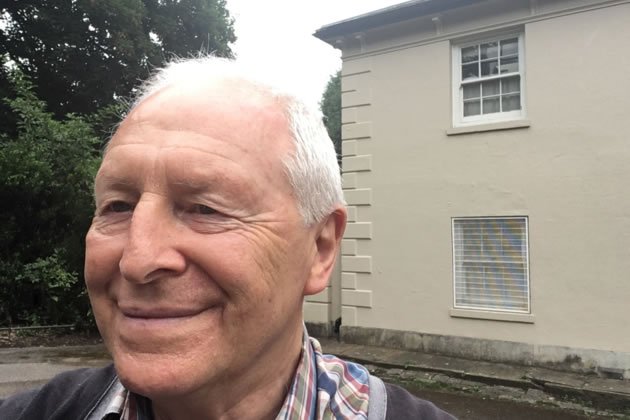
Barry Martin in front of his studio at The South Lodge in Chiswick House Gardens
January 5, 2026
Barry Martin, the kinetic artist, painter, sculptor, performer and chess aficionado whose restless imagination made him one of Britain’s most original creative figures, has died aged 82. He spent more than three decades as the resident artist at Chiswick House, where he worked, researched, taught and welcomed generations of visitors, actors and fellow artists into a unique studio.
He moved into the semi-derelict gate lodge at Chiswick House in 1989, taking on the lease and restoring the building with the architect Theo Crosby. What began as a practical solution for studio space soon became a defining chapter of his life. The lodge, tucked into the edge of Lord Burlington’s Palladian estate, became both a creative laboratory and a social hub — a place where ideas, drawings, kinetic experiments and conversations flowed as freely as the light through the surrounding gardens.
From this unlikely base, Barry immersed himself in the history and symbolism of Chiswick House. He became fascinated by the architectural language of the villa and its garden structures, eventually publishing research arguing that the building’s original purpose was deeply connected to Freemasonry. His interpretations were characteristically bold, imaginative and meticulously argued, reflecting the same curiosity that animated his art.
Chiswick also became the setting for some of Barry’s most memorable collaborations. A gifted portraitist, he drew a circle of actors to his studio, including Peter Egan, Ian Holm, John Alderton and Pauline Collins. He was deeply affected by the death of the latter who predeceased him by a few weeks. His self-portraits, by contrast, were theatrical and enigmatic: life-size chalk studies in which he appeared robed and symbol-laden, as though haunting the grounds as a nocturnal guardian of the estate’s secrets.
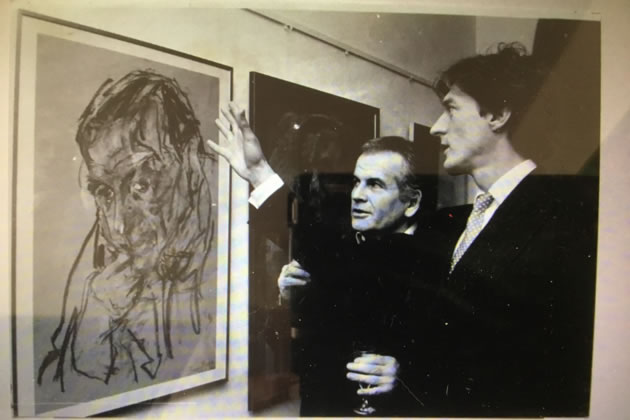
Ian Holm and Nigel Havers admiring the artist’s portrait of Ian Holm at The South Lodge
In 2014 he staged one of the most unusual artistic events ever held in the gardens: a performance with the principal choreographer and dancers of Ballet Rambert, using the garden temples as a stage for a four-part exploration of rhythm, architecture and movement. It was a quintessentially Martin project — playful, intellectual, visually striking and rooted in the landscape he knew so well.
Although his reputation extended far beyond Chiswick — from the Hayward Gallery to the Tate, from kinetic sculpture to performance art, from Studio International to the world of competitive chess — he remained deeply attached to the community around the house and its park. Local residents grew accustomed to seeing him at work, sketchbook in hand, or deep in conversation about art, architecture or the latest chess controversy. His presence became part of the fabric of the place.
Barry’s wider career was similarly eclectic. A pioneer of Kinetic Art in the 1960s and 70s, he created motorised sculptures and light works of remarkable precision, many of which still function today in major collections. He taught at Goldsmiths, Central Saint Martins, the Royal College of Art, the Slade and the Royal Academy, influencing generations of artists. His fascination with chess — shared with his hero Marcel Duchamp — led him to co-organise the Chess and Art Symposium at Tate Britain, captain the Chelsea Arts Club chess team, and serve as official artist for the 1993 World Chess Championship.
Barry Martin is survived by his wife, Sarah, and their daughter, Jessie. His work remains in major museums in Britain and abroad, and his name lives on through the Barry Martin Award for Experimental Art at Central Saint Martins.
Like Reading Articles Like This? Help Us Produce More This site remains committed to providing local community news and public interest journalism. Articles such as the one above are integral to what we do. We aim to feature as much as possible on local societies, charities based in the area, fundraising efforts by residents, community-based initiatives and even helping people find missing pets. We’ve always done that and won’t be changing, in fact we’d like to do more. However, the readership that these stories generates is often below that needed to cover the cost of producing them. Our financial resources are limited and the local media environment is intensely competitive so there is a constraint on what we can do. We are therefore asking our readers to consider offering financial support to these efforts. Any money given will help support community and public interest news and the expansion of our coverage in this area. A suggested monthly payment is £8 but we would be grateful for any amount for instance if you think this site offers the equivalent value of a subscription to a daily printed newspaper you may wish to consider £20 per month. If neither of these amounts is suitable for you then contact info@neighbournet.com and we can set up an alternative. All payments are made through a secure web site. One-off donations are also appreciated. Choose The Amount You Wish To Contribute. If you do support us in this way we’d be interested to hear what kind of articles you would like to see more of on the site – send your suggestions to the editor. For businesses we offer the chance to be a corporate sponsor of community content on the site. For £30 plus VAT per month you will be the designated sponsor of at least one article a month with your logo appearing if supplied. If there is a specific community group or initiative you’d like to support we can make sure your sponsorship is featured on related content for a one off payment of £50 plus VAT. All payments are made through a secure web site. |